


Diamonds had value before servers had economies
Diamonds entered Minecraft long before modern server economies, but the ingredients were there early. Minecraft Wiki records diamonds in Java Indev 0.31 in January 2010, first under the old internal "emerald" naming, then quickly renamed to diamonds. Within days they were tied to high-tier tools, blocks, and later armor. Over time, that value widened: enchanting tables, beacon payments, villager trades, smithing templates, armor trims, and netherite equipment all kept diamonds connected to progression rather than pure decoration.
That matters for vanilla SMP history because a good currency needs more than rarity. It needs confidence. Dirt is recognizable but too common. Emeralds are official trading tokens, but villagers and farms can make them feel detached from mining. Netherite is valuable, but too late-game and too awkward for ordinary pricing. Diamonds sat in the middle: rare enough to matter, simple enough to count, and useful even if no one else wanted to trade.
Why diamonds worked as player money
The old community debates make the pattern clear. A 2010 Alpha SMP forum thread was already talking about currency traits like portability, renewability, demand, and duplication risk. Players argued over gold, diamonds, mossy cobblestone, glowstone, iron, and other candidates, but the recurring test was practical: can players carry it, can they farm it endlessly, and will its value collapse when one project changes demand?
Diamonds passed enough of those tests to become the informal default on many vanilla servers. They stack to 64, compress into blocks, come from exploration or mining rather than simple crop loops, and remain legible to new players. A 2013 Minecraft Forum discussion put the social memory plainly: players were already treating diamond as a standard vanilla-server currency because it was rare, desirable, and continually burned through tools and armor.
For a minecraft SMP, that backing matters more than officialness. A player can spend diamonds in a shop, save them for gear, build with diamond blocks as a status symbol, or keep them as emergency wealth. That optionality is what turned diamonds from valuable loot into money.
Shops made diamonds feel normal
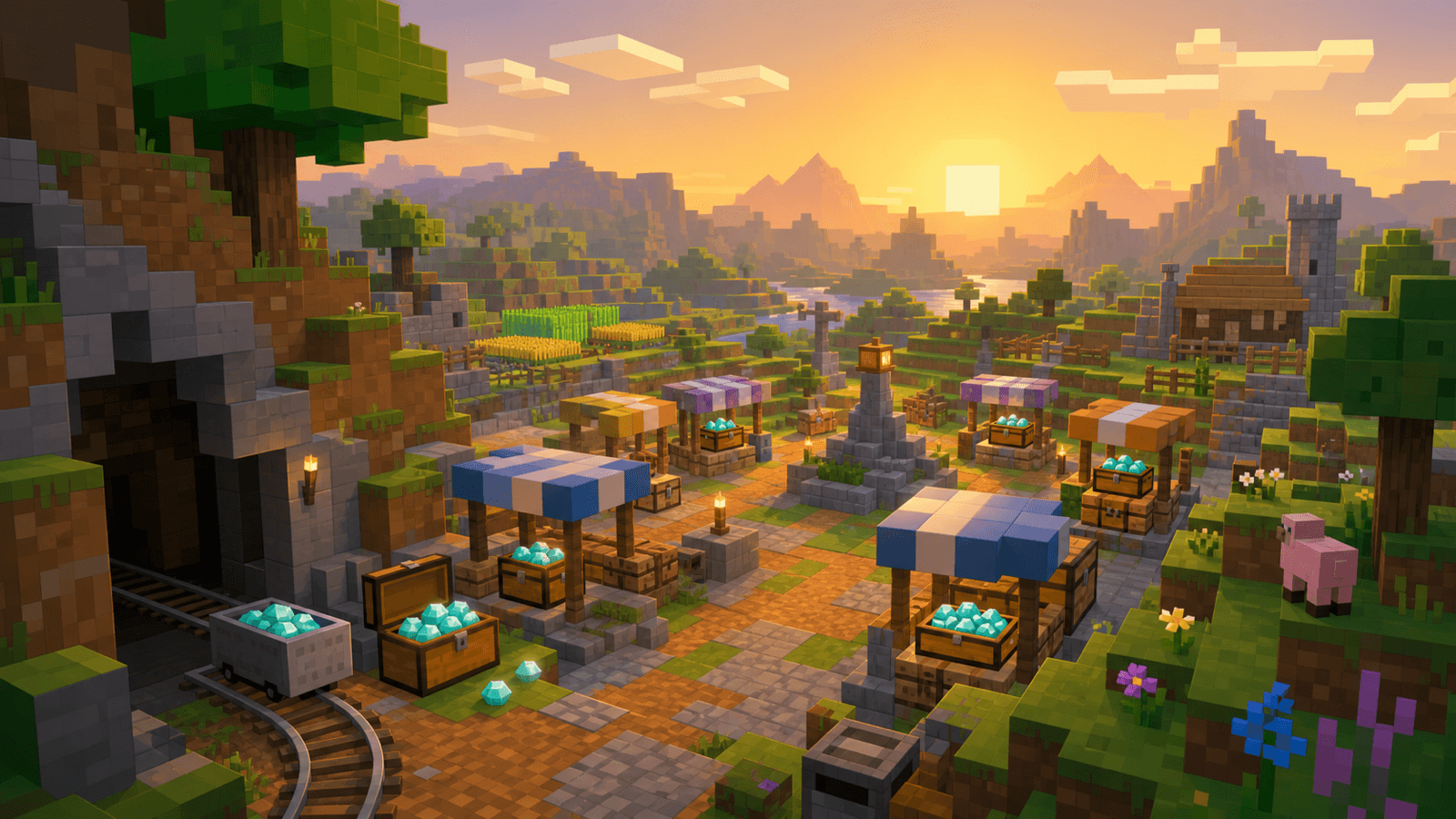
Diamonds became currency most visibly when servers built shopping districts. Once players put stock in chests and marked prices in diamonds, the social habit reinforced itself. One diamond could buy a stack of building blocks, a few diamonds could buy gear or books, and diamond blocks could price bulk goods without writing a long barter contract every time.
That is why diamond economies feel especially natural on vanilla SMP worlds that avoid command money. The server does not need a balance command, a scoreboard wallet, or a custom coin item. Players can walk to a shop, put diamonds in a payment chest, take the goods, and understand the exchange even if they joined yesterday. That is also why creator SMPs made the pattern famous: the format is visible, simple, and easy to copy.
The same idea appears in long-running public worlds, even when they add extra systems. The local Peaceful Vanilla Club corpus describes Bank O Notes as a currency that can be exchanged with diamonds, emeralds, and other valuables. That kind of system does not erase diamond value; it shows how many servers still use diamonds as a trusted reference point even when they add convenience around trade.
Diamond money has real limits
Diamonds are useful currency, not perfect currency. Admin discussions are blunt about the tradeoffs. In a small or mid-sized vanilla SMP, diamonds often regulate themselves well because they are hard to farm directly and players keep finding uses for them. On a larger server, one organized mining rush can dump enough diamonds into circulation to distort prices for a week. A one-diamond minimum price can also lock newer or poorer players out of casual trade.
Those problems are not failures of vanilla. They are signs that the server needs rules matching its size. A small friend server might work fine with direct negotiation, trust shops, and a loose diamond standard. A public economy with dozens of active players may need smaller units, posted price ranges, anti-dupe enforcement, shop limits, or a plugin currency that still respects vanilla progression.
This is where the phrase "vanilla economy" can become misleading. A server can use diamonds and still be heavily managed. Another can run no plugins and still have a chaotic market if nobody explains prices, grief rules, or shop etiquette.
Read diamond economies as server culture
When you compare worlds on the vanilla SMP server list, diamond currency is a useful signal, but it is not automatically a guarantee of quality. The stronger question is what the diamond economy reveals about the community. Are shops trusted? Are payment chests protected by rules or claims? Are prices public enough that new players can participate? Does the server reset often, or does wealth accumulate for years?
Diamond economies also expose how a server thinks about progression. If spawn hands out diamond gear, diamonds stop meaning mining time. If every valuable item comes from an overpowered public farm, diamonds become a decoration tax. If shops price everything in full diamonds with no smaller unit, early players may feel poor even when the world is otherwise welcoming.
Better questions before joining
The best vanilla SMP communities make trade understandable. They do not need a perfect economic model, but they should explain whether the world uses diamonds, emeralds, barter, plugin money, player shops, admin shops, or no organized economy at all. That clarity helps players decide whether the server fits their preferred pace.
For more history-driven selection habits, the Minecraft history archive is useful, especially topics like Indev starter support and old multiplayer travel. The practical takeaway is simple: diamonds became SMP currency because vanilla players could trust what they represented. Choose the server where that trust is still visible in the rules, shops, and first-week experience.