
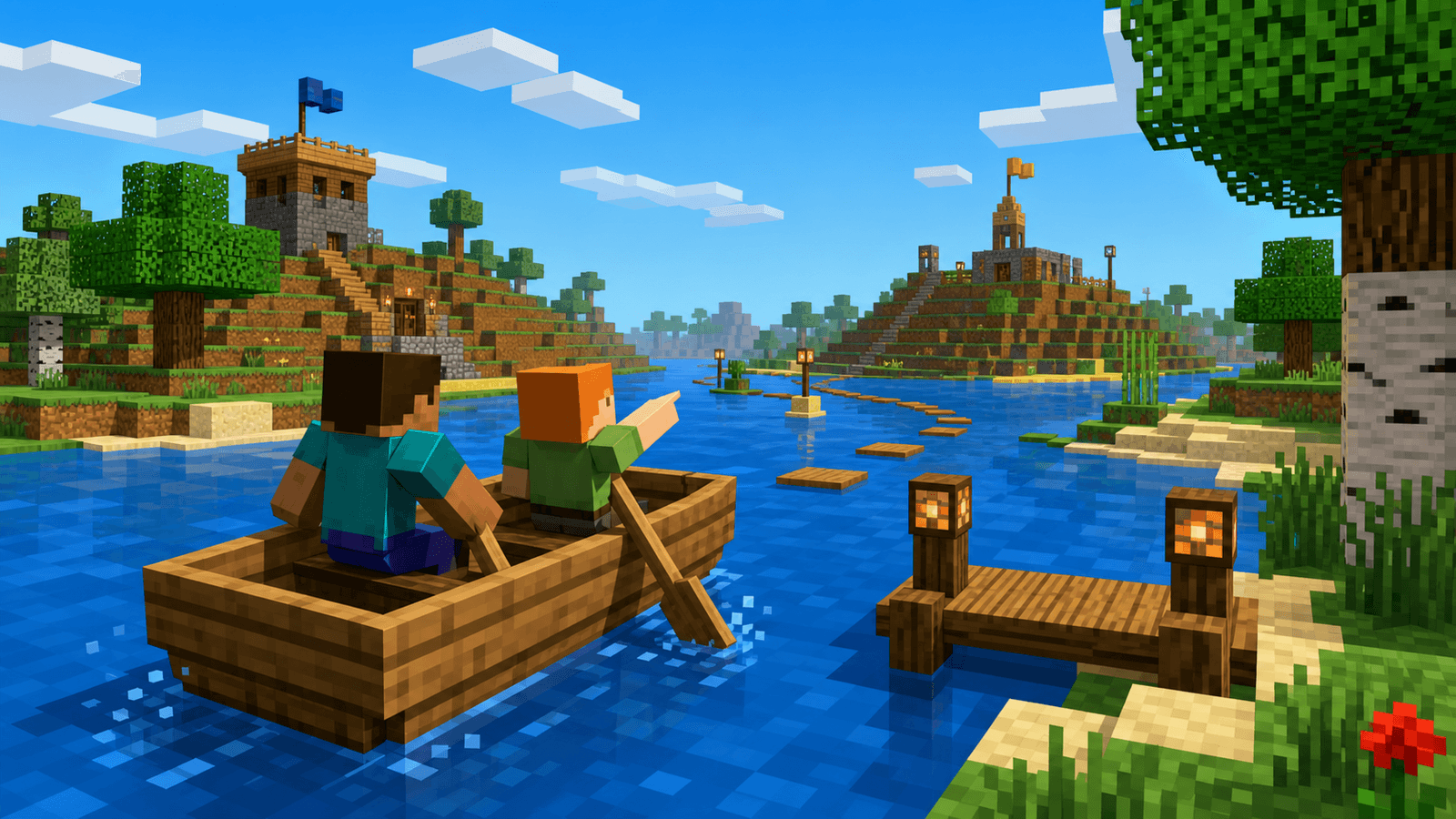

Old boats made water feel risky
Boats were one of Minecraft's first answers to distance. A river, coast, or ocean could turn a remote base from an isolated build into a reachable outpost. That mattered in early multiplayer because players did not have elytra, shulker boxes, modern Nether roof habits, or polished server transit networks to smooth every trip. If two groups lived far apart, water could be the difference between visiting and never bothering.
The catch was fragility. Minecraft Wiki's boat history records that Java Alpha v1.0.6 boats initially broke when placed outside water and on impact with land. A quick follow-up made them break only on high-speed land impact, but the identity stuck: early boats were fast enough to matter and fragile enough to make every shoreline approach feel tense.
That combination shaped behavior. Players carried spare boats. They slowed down before shorelines. They treated lily pads, narrow rivers, and awkward docks as hazards instead of decoration. On a solo world, that was an inconvenience. On vanilla Minecraft servers, it changed group travel: a bad landing could scatter players, waste materials, or turn a simple meetup into a delay.
Multiplayer made every flaw louder
The old boat problem was not only that boats broke. It was that breakage felt unpredictable in multiplayer. Community memories of pre-1.9 boats often revolve around desync, sudden impacts, and boats breaking when the player believed they were still clear of land or obstacles. Even when those memories are exaggerated by nostalgia, they point to a real server-selection issue: movement mechanics feel different when latency, shared routes, and group expectations enter the picture.
Minecraft's own 1.9 notes make that multiplayer angle visible. The boat changes included different player movement handling to reduce client-server desync. That is not a cosmetic detail. It means the old travel experience was partly a networking and control problem, not just a funny vehicle quirk.
For early server communities, that made water travel a trust test. A server could claim it had a beautiful connected coastline, but the real question was whether the map made travel pleasant under the mechanics of that version. If a public path constantly broke boats, players would stop using it and fall back to walking, Nether portals, rails, or informal shortcuts.
1.9 turned boats into infrastructure
The Java 1.9 boat overhaul changed the category. Boats gained oars, new controls, more durability, passengers, and the ability to travel extremely fast on ice and packed ice. The old generic boat became the oak boat, wood variants arrived, and boats started to feel less like disposable rafts and more like a reliable movement system.
That changed multiplayer planning. Two players could travel together in one boat. Mobs and armor stands could ride, which opened practical uses beyond crossing water. Ice and packed ice turned boats into high-speed routes, making player-built highways and race tracks part of vanilla movement culture. The modern boat is still simple, but it supports public infrastructure in a way the older version could not.
The change also separated old-version nostalgia from current vanilla expectations. A 1.8.9 server and a current Java server can both call themselves vanilla, but their travel assumptions are not the same. One has old boat physics; the other has the post-1.9 boat model that made ice travel and shared riding normal. That distinction matters more than a listing's mood words.
Boat history is a server-listing filter
When comparing vanilla Minecraft servers on the homepage server list, boat history gives you a sharper way to read travel claims. If a listing says "classic survival," does that mean an old jar with old boat behavior, a modern server with nostalgic builds, or a current vanilla world with no teleport economy? If it advertises highways, are those Nether portals, rail lines, ice roads, blue-ice boat lanes, or ordinary river paths?
Those questions are not nitpicks. Travel defines how often players meet, trade, explore, and recover after death. A server with no teleport commands needs honest infrastructure. A server with frequent resets can tolerate messy routes because the world is temporary. A long-running world needs travel systems that stay legible for new players months after the original builders stop explaining them.
This is the same reading habit that helps with smaller history details, including boat-related villager trading trivia and broader mechanics history in the Minecraft history archive. The useful question is not whether a feature sounds nostalgic. It is what the player will actually experience after joining.
Good servers explain how players move
The best vanilla Minecraft servers do not need a giant transit manual, but they should explain the basics. Are warps disabled? Is the Nether roof allowed? Are ice roads common? Does the server run a modern version where boats are reliable, or an old version where water travel has old risks? Are public routes protected by rules, claims, or simple community etiquette?
Boat history matters because it reveals how quickly a small mechanic becomes social. A fragile boat turns a dock into a design problem. A two-seat boat turns a scouting trip into a shared ride. A fast ice boat turns distance into infrastructure. A server listing that understands those differences is more likely to be honest about other vanilla boundaries too.
Better questions before joining
Before joining a server, turn the travel pitch into concrete checks. If the listing promises a pure vanilla world, ask what version it runs and whether movement is changed by plugins. If it promises old-school survival, ask whether that includes old boat behavior or only a nostalgic spawn style. If it promises a connected world, ask how new players find public routes without relying on private Discord lore.
Old boats are worth remembering because they show how transportation rules shape community habits. Fragile travel made players cautious. The 1.9 overhaul made boats reliable enough for shared routes, passengers, and ice highways. For players using a Minecraft server list, that history turns a vague promise like "great exploration" into better questions about version, distance, infrastructure, and whether the server's vanilla claim matches the journey you will actually take.