
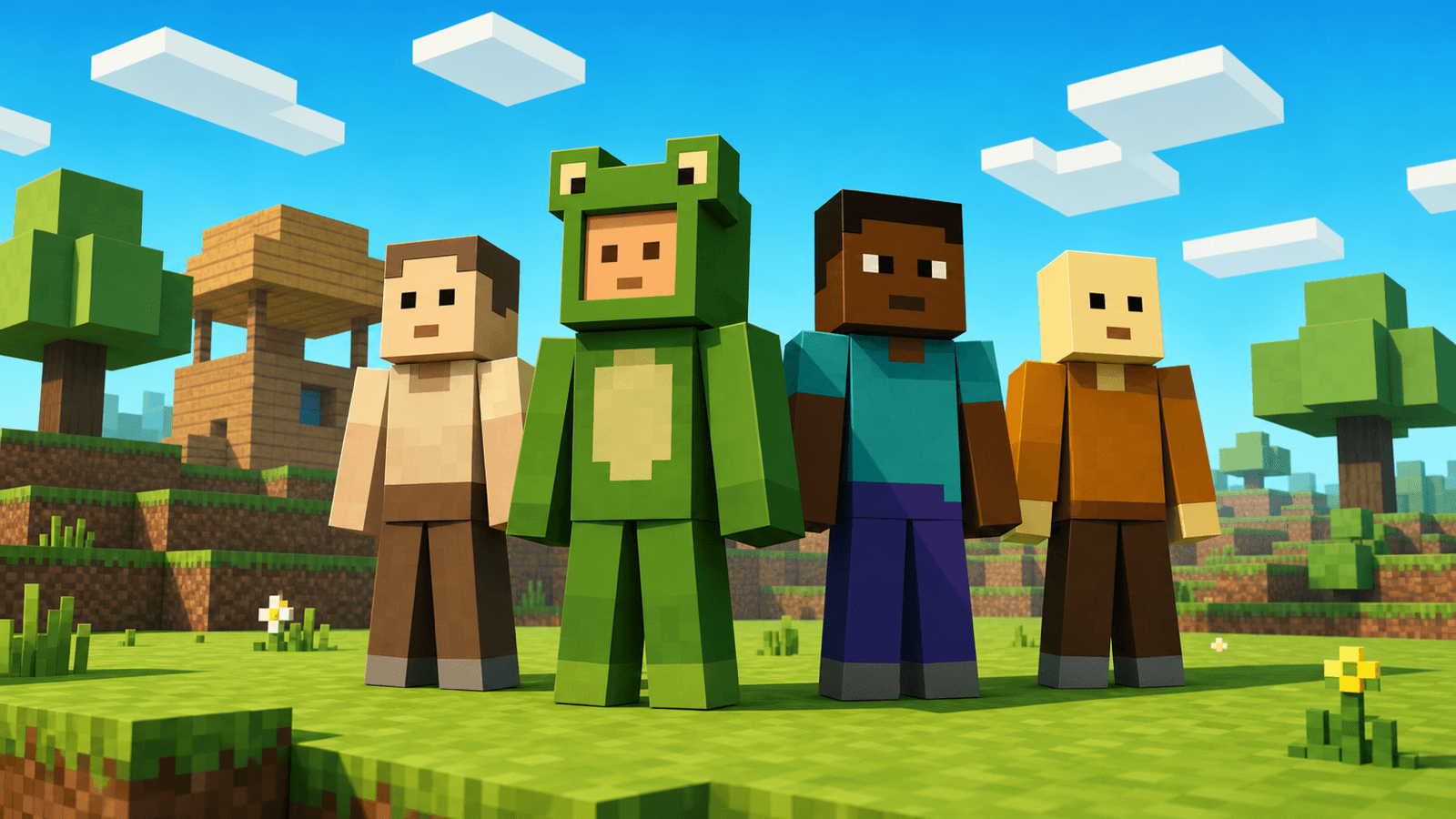

Indev briefly tested a different kind of human mob
Rana and the other removed human mobs belong to Minecraft's Indev period, when the game was still moving from rough survival experiments toward the shape players now recognize. Minecraft Wiki describes Indev as the phase that introduced paid public testing, limited configurable worlds, crafting, tools, smelting, food changes, dynamic lighting, and support for MD3 mob models. That last detail is where Rana enters the story.
The early mob was not a modern NPC system. It was a passive entity used across very early Minecraft versions, and its model changed several times. During part of Indev, the mob used Rana, a girl in a frog outfit based on a character by Dock, the artist working with Notch at the time. Later, other variants appeared: the player community commonly calls them Steve, Black Steve, and Beast Boy.
That context matters because these characters are easy to overstate. They look like a path Minecraft could have taken toward human companions, roaming NPCs, or character-driven survival. In practice, they were closer to a visible test of entity models, drops, movement, and art direction during a fast-changing development phase.
The names are mostly community history
The names around these mobs are part of the confusion. Minecraft Wiki's mob entity page notes that "Steve," "Black Steve," and "Beast Boy" were unofficial fan terms that spread because the variants lacked known official names. This was before the default player character was commonly fixed in player memory as Steve. So when old screenshots show "Steve" as a mob, the name does not mean the modern player character had become a roaming NPC.
The behavior was also much simpler than the names suggest. The early mob wandered, jumped, and existed as a passive test entity. In the January 30, 2010 Indev build, the model variants affected drops: the Steve variant could drop string, Black Steve could drop gunpowder, and Beast Boy could drop feathers. That sounds strange now, but it fits the moment. Minecraft was still deciding how survival resources, mobs, crafting, and danger would fit together.
Community discussions still show how blurry this can get. Players rediscover Rana through screenshots, fan skins, marketplace-style references, or old-version videos, then ask whether she was an NPC, a first mob, a forgotten girlfriend-style character, or a removed villager ancestor. The most accurate answer is narrower: Rana was one appearance of the early passive mob entity during Indev, not a modern social system that vanilla servers can simply "turn back on."
Their removal shows Minecraft choosing a cleaner survival language
The timeline is short. Rana appeared through early Indev builds, the Steve and Black Steve variants arrived near the end of January 2010, Beast Boy appeared around January 30, and the alternate model variants were quickly replaced. By February 2, 2010, the old human-style mob was removed as familiar Survival Test mobs such as pigs, sheep, zombies, skeletons, spiders, and creepers returned to the survival loop.
That shift tells a clear design story. Minecraft did not keep wandering human model tests as the backbone of survival. It moved toward animals, monsters, resource drops, and simple silhouettes that communicated function quickly. A pig, spider, creeper, or skeleton tells a player what kind of encounter is happening. Rana and the other human variants were more ambiguous. Were they people, monsters, helpers, jokes, or placeholders?
For modern vanilla Minecraft servers, this is more than trivia. Server players depend on shared expectations. A world can support long-term trust when players understand which mobs are standard, which mechanics are changed, and which parts of the experience come from plugins, datapacks, resource packs, or old-version recreation.
Removed human mobs are a server-selection filter
When you compare vanilla Minecraft servers on the homepage server list, Rana and Black Steve are useful because they expose vague language. A listing that says "old Minecraft feeling" might mean a quiet survival community with no economy plugins. It might mean Beta-style terrain. It might mean custom mobs dressed as old prototypes. It might also mean very little beyond atmosphere.
That distinction matters before you invest in a base, join a group, or bring friends into a world. A strict vanilla server cannot add Rana, Black Steve, or Beast Boy as functioning mobs without leaving current vanilla mechanics. A historical server can run an old client version. A semi-vanilla server can recreate them with plugins or mods. All of those can be fun, but they are not the same offer.
The broader Minecraft history archive helps because removed features sharpen the questions players should already be asking. Does the server preserve vanilla mechanics or only vanilla aesthetics? Are custom entities cosmetic, functional, hostile, or tied to rewards? Are old features recreated honestly, or used as vague nostalgia to make a heavily modified world sound simpler than it is?
Ask what the server actually changes
The practical lesson is not that every server should avoid old-feature references. Minecraft history is part of the fun. A community can build museums, host old-version events, or run resource-pack tributes without misleading anyone. The problem starts when removed-feature language hides mechanical changes that affect survival.
If a server adds custom human mobs, those mobs can change farming, combat, drops, lag, pathfinding, moderation, and player expectations. If a server only uses old models as decoration, the impact is much smaller. If it runs a true Indev recreation, then nearly everything changes: world size, saves, mobs, crafting assumptions, stability, and the meaning of "vanilla" itself.
Those questions keep the nostalgia useful. Rana, Black Steve, Steve, and Beast Boy are fascinating because they show Minecraft before its survival language settled. They also remind players that "vanilla" is not just a mood. It is a mechanical promise. The best vanilla Minecraft servers state that promise plainly, especially when they borrow the names, imagery, or mystery of features that disappeared before modern Minecraft existed.