
The Halloween Update made Minecraft feel larger
Before the Halloween Update, Minecraft's promise was already enormous, but it was mostly horizontal: walk, dig, build, and find the edge of whatever the current world generation could offer. Alpha v1.2.0 changed the scale of the game by adding a separate dimension instead of simply extending the Overworld. Mojang's later history of the Nether describes the choice as deliberate. The Nether was not discovered under the surface; it was added to make Minecraft more terrifying and to give players a hostile place with resources worth the trip.
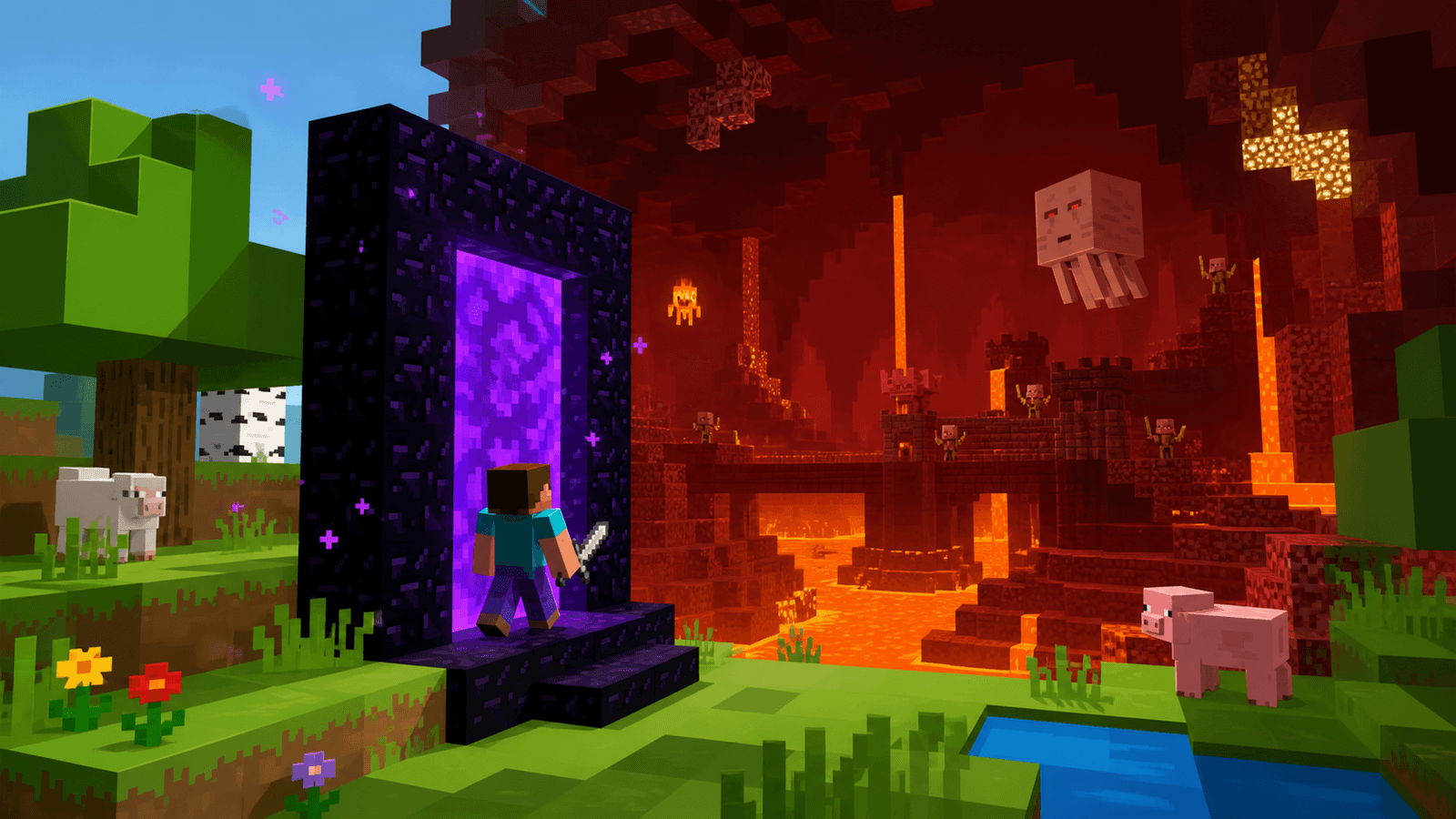
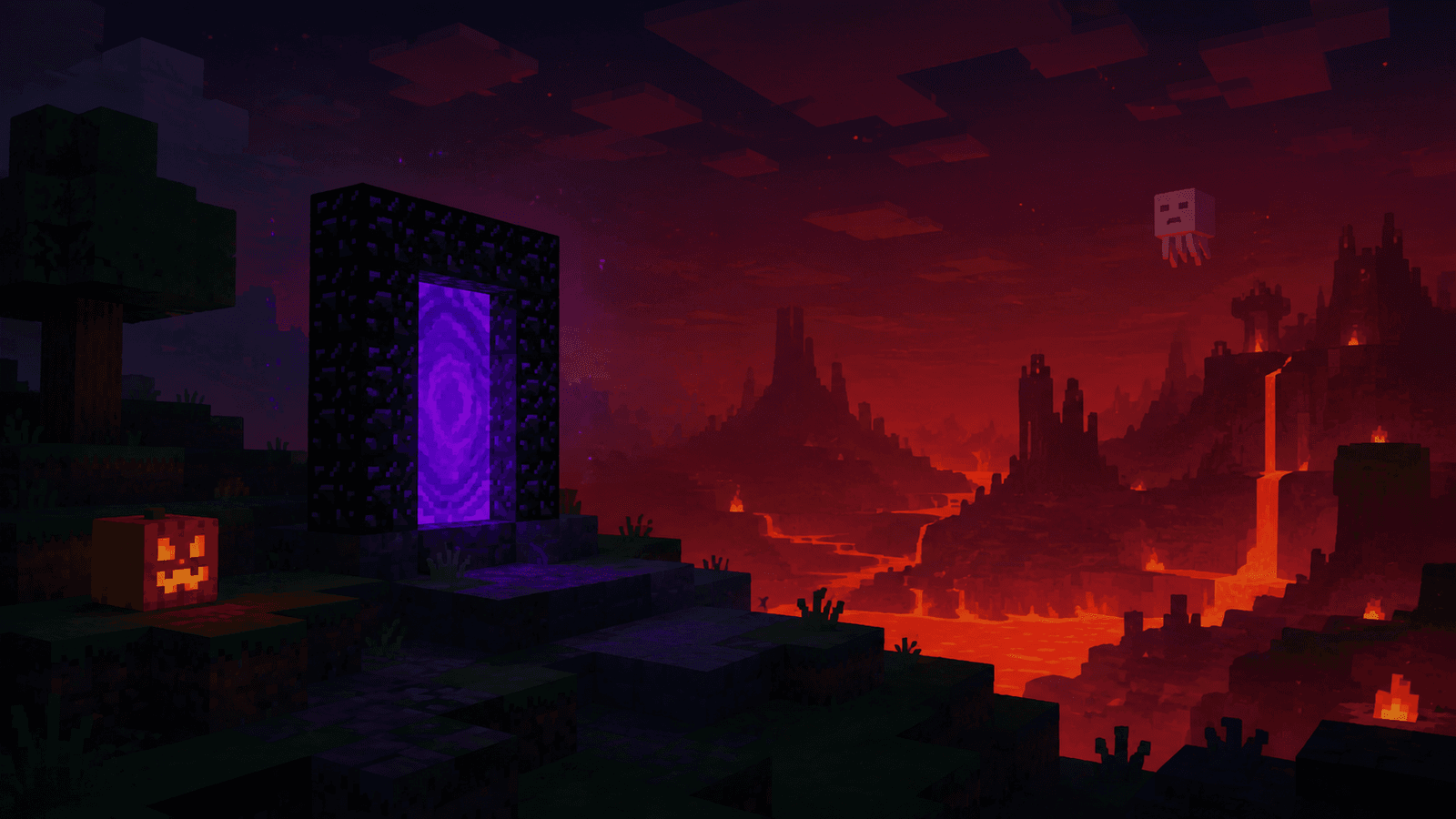
That distinction is why the update still reads as a turning point. A new biome can add scenery. A new dimension changes the meaning of distance, preparation, storage, and return. The original Nether was visually sparse compared with the modern version, but it already had the essentials of a separate survival problem: lava, cliffs, red fog, ghasts, zombie pigmen, soul sand, glowing blocks, and netherrack that could burn indefinitely. The world had a recognizable identity before it had a long list of biomes.
The Halloween framing also mattered culturally. Mojang's own retrospective places the Nether beside the period's other additions, including sunrises, fish, and jack-o-lanterns. It was not a temporary event world. The scary theme became permanent infrastructure, which is an unusually Minecraft-like move: a seasonal idea turned into a place that could anchor years of survival play.
Danger gave the second world a reason to exist
The Nether worked because it was not just a red copy of the Overworld. Its danger had a job. Ghasts could attack from open air and set the landscape on fire. Soul sand slowed movement. Lava made ordinary mistakes expensive. Water could not be used normally as an emergency tool. The player had to think about blocks, food, flint and steel, and the location of the exit before treating the portal as a doorway.
Mojang's later explanation of the Nether still describes the same basic loop: players enter for an extra challenge or for resources that cannot be gathered safely elsewhere. That is a useful design test for any vanilla SMP. A hostile region earns its place when the rewards create reasons for groups to accept the risk. If the danger is only decorative, players bypass it. If the rewards are too powerful or too easy, the dimension becomes a mandatory checklist instead.
The early Nether also carried a strong sense of unfinished technology. Portals required players to stand still inside the purple haze, loading screens separated the worlds, and the first multiplayer implementations did not always line up neatly with singleplayer expectations. That roughness is part of the history, but it should not be romanticized into a false claim that every early server had the same access.
Multiplayer made the Nether less simple
The phrase “the Nether was added in 2010” hides an important server detail: singleplayer availability and multiplayer support did not mature at exactly the same pace. A current r/GoldenAgeMinecraft discussion from an Alpha 1.2.6 server owner shows the practical problem. The group wanted Nether materials and shorter travel, but moving to a later server implementation risked breaking Alpha-specific bugs and the world culture built around them. The solution was not a clean switch; it involved modified server software, compatibility compromises, and backup concerns.
That is a useful reminder for anyone who joins a historical or version-locked minecraft SMP. “The Nether exists” is not enough information. Players need to know which client and server versions are supported, whether portal travel is native, what world data has been upgraded, and whether the server treats old bugs as part of its identity. A server can preserve an old atmosphere while quietly changing the mechanics that made that atmosphere work.
These questions are more useful than nostalgia alone. A player who wants the earliest possible survival experience may value the friction. Another player may want a modern vanilla SMP with the Nether's resources but none of the old server instability. Both preferences are reasonable; they just describe different worlds.
Portals turned travel into community infrastructure
The Nether's most durable multiplayer consequence may be travel. Contemporary previews and forum discussions focused on compressed distance: move through a smaller amount of Nether space and emerge much farther away in the Overworld. In a modern world, that sounds like a normal utility. In early Minecraft, it competed directly with the huge minecart lines and stations that players were building across the surface.
Current Golden Age Minecraft players still describe that tradeoff. Some see the Nether mainly as a fast-travel layer and a source of glowstone, lava, or other unique materials. Others miss the older Overworld rail systems and feel that Nether travel damaged the atmosphere of surface infrastructure. Neither view is merely about efficiency. Each one describes a different multiplayer culture: a world where distance is conquered by shared roads, or one where portals become the hidden highways behind every base.
That is why portal rules deserve attention on a vanilla SMP. A shared hub can make distant settlements feel connected. A careless portal can appear inside a build, expose new players to danger, or turn an unexplored region into a private shortcut. Good communities treat coordinates, signage, rescue routes, and maintenance as part of the world rather than as invisible administration.
The Nether therefore belongs in the same conversation as old minecart travel. Infrastructure is never just transport in a shared world. It decides which places become social, which bases remain isolated, and whether a new player can join an established map without needing a private guide.
What the Halloween Update still teaches server owners
The Halloween Update's lasting achievement was not simply adding a famous dimension. It established a pattern that vanilla Minecraft still follows: a new place should create a new kind of decision. Enter the Nether for a reward, but accept exposure. Build a portal for convenience, but accept responsibility for the route. Preserve a historical version for atmosphere, but explain the compatibility cost.
That pattern is a practical filter when comparing vanilla Minecraft servers. Look for listings that explain world age, version policy, Nether access, resets, and whether infrastructure is player-built or staff-managed. The best vanilla SMP is not automatically the oldest, hardest, or most optimized. It is the one whose rules make the tradeoffs legible before players invest time in a shared home.
The Minecraft history archive helps put that choice in context: earlier updates repeatedly turned technical changes into social habits. The Halloween Update did it first at dimension scale. The Nether began as a frightening parallel map, then became a travel network, resource frontier, and shared memory that every serious survival community has to interpret for itself.
Choose the world whose Nether you understand
When you browse vanilla SMP servers, use the Halloween Update as a simple question: what does this community expect the Nether to be? A dangerous expedition? A public road system? A resource zone with protected hubs? A historical artifact? The answer will affect your first base, your friendships, and the amount of world you can realistically reach.
The birth of the Nether made Minecraft larger, but it also made server promises more specific. If a listing explains its version, portal policy, travel culture, and approach to shared infrastructure, you can decide whether that world fits. If it only says “vanilla” and leaves those details hidden, keep researching before you commit.